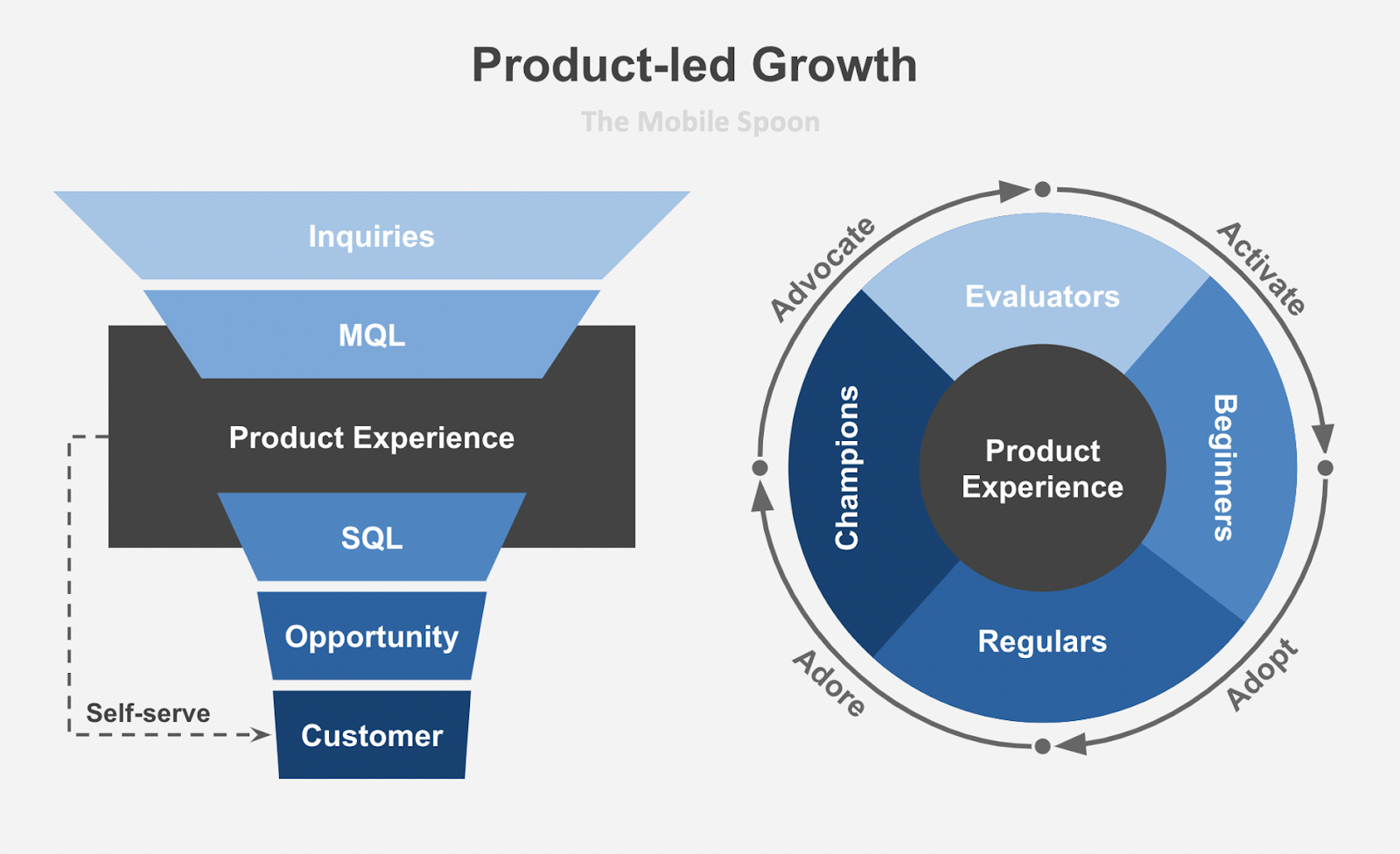
What Product-Led Growth Is and Why It Works
Product-led growth (PLG) is the go-to-market strategy in which the product itself — rather than the sales team or the marketing team — is the primary mechanism through which users discover the product, experience its value, and convert to paying customers. The PLG model inverts the conventional enterprise software sales model in which the sales team identifies the prospect, persuades the prospect to evaluate the product, manages the evaluation process, negotiates the contract, and then hands the new customer to the customer success team for implementation — replacing this sales-intensive, capital-intensive process with the product experience that most efficiently distributes itself, most directly demonstrates its value, and most effectively converts the user who has experienced the value to the customer who is willing to pay for it.
The PLG business model economics that most clearly explain why the approach has become the dominant go-to-market strategy for the fastest-growing B2B software companies: the customer acquisition cost (CAC) reduction that the self-serve, product-driven acquisition most dramatically produces relative to the sales-assisted acquisition whose per-customer cost most consistently exceeds the PLG alternative by multiples. The PLG company that acquires customers through the freemium product that users discover, adopt, and convert independently pays the infrastructure cost of the product and the minimal marketing cost of the content and the SEO that drives organic discovery — a CAC that most commonly represents a fraction of the fully-loaded cost of the enterprise sales representative whose salary, benefits, quota attainment incentive, and management overhead most represent the primary cost of the sales-assisted customer acquisition. The CAC reduction that PLG most directly produces enables the profitable growth at scale that the sales-intensive model most commonly achieves only after the revenue per customer has grown to the level that amortises the high per-customer acquisition cost.
Designing the PLG Flywheel
The PLG flywheel design that most effectively creates the self-reinforcing growth dynamic that the product-led approach is designed to produce: the acquisition mechanism (the specific channel and the specific entry point through which the user first encounters the product — the freemium tier, the free trial, the viral sharing feature, or the integration with the tools the user already uses that most naturally introduces the product into the user’s existing workflow), the activation mechanism (the specific product experience that most effectively delivers the first genuine value to the new user within the timeframe that most retains their attention and most motivates the continued engagement that the conversion to a paying customer requires), the retention mechanism (the specific product features, the specific workflows, and the specific data accumulation that most effectively create the usage habits and the switching costs that most motivate the long-term continued usage that the PLG flywheel’s expansion revenue most requires), and the expansion mechanism (the specific product features, the specific team collaboration invitations, and the specific usage-based pricing triggers that most naturally cause the individual user’s value extraction to grow in the ways that the product’s commercial model most effectively converts into expanding revenue).
The virality mechanism that most effectively converts each new user into the acquisition channel that generates the next user without the additional marketing investment that the external acquisition channel would require: the in-product sharing feature (the specific product action — the shared document, the collaborative workspace invitation, the published output with the brand attribution — that most naturally introduces the product to the new user while delivering genuine value to both the sharing user and the receiving new user), the network effect feature (the specific product capability that becomes more valuable to each user as more users join the network — the communication platform, the marketplace, the collaborative tool — whose value proposition most effectively converts each user into the evangelist whose self-interested promotion of the product simultaneously serves the user’s own value-maximisation and the product’s customer acquisition), and the integration-driven discovery (the specific integration with the tools that the target user already uses that most naturally exposes the product to the target user in the context where the product’s specific value is most immediately relevant).
The Free Tier Design
The freemium tier design that most effectively acquires the large volume of users whose engagement data most informs the product development, whose network effects most increase the product’s value, and whose free usage most directly generates the conversion pipeline that the business’s revenue depends on: the free tier that provides enough genuine value to the target user to motivate the sign-up and the continued usage, without providing so much value that the paid upgrade’s specific additional benefits are insufficient to motivate the conversion that the business model requires. The free tier that provides the core value without the specific scaling, the specific collaboration, the specific security, or the specific integration that the power user most requires is the free tier that most effectively serves both the user acquisition objective (enough value to motivate adoption) and the conversion objective (clear, specific benefits that motivate the paid upgrade for the users whose usage most warrants the upgrade).
The free trial design that most effectively converts the trial user to the paying customer by the end of the trial period: the time-limited full access trial (the fourteen or thirty-day period during which the user has complete access to the product’s full feature set, after which the access reverts to the free tier or terminates unless the user upgrades) combined with the activation programme that most deliberately guides the trial user to the specific product experiences whose value most compellingly motivates the conversion decision before the trial period expires. The free trial whose activation programme most successfully engineers the trial user’s experience of the product’s most compelling value within the first three to five days of the trial period is the trial programme that most consistently converts the trial user to the paying customer before the trial expiration creates the payment urgency that the unactivated user most commonly resolves by allowing the trial to lapse.
Converting Free to Paid
The free-to-paid conversion approach that most effectively triggers the upgrade decision at the moment when the user’s engagement most clearly signals the readiness to convert: the usage-based upgrade trigger that presents the upgrade prompt at the specific product moment when the user encounters the specific limitation that the free tier imposes — the storage limit reached, the team member invitation limit reached, the advanced feature access attempted — rather than the calendar-based prompt that presents the upgrade request at the defined time interval regardless of whether the user’s usage has reached the specific point where the upgrade’s value is most immediately apparent. The upgrade prompt that appears in the specific moment when the user most directly experiences the specific limitation that the paid tier most immediately removes is the prompt that most effectively converts the experienced limitation into the upgrade decision.
The sales-assisted conversion motion that most effectively complements the self-serve PLG conversion for the high-value accounts whose conversion to the enterprise tier most significantly increases the business’s revenue: the product-qualified lead (PQL) identification that uses the specific product usage signals — the number of users invited, the frequency and the depth of the engagement with the most advanced features, the specific use cases that indicate the enterprise application — to identify the free or SMB tier accounts whose current product engagement most clearly indicates the readiness for the enterprise conversation that the sales team most productively pursues. The PLG company that deploys the sales-assisted conversion specifically for the PQL accounts whose product engagement most signals the enterprise opportunity is applying the sales resource most efficiently by targeting the accounts most likely to convert and most likely to convert to the highest value tier.
Measuring PLG Performance
The PLG metrics that most accurately track the health and the growth trajectory of the product-led growth engine across its complete flywheel: the acquisition metrics (the new user sign-up rate and the source of each user’s discovery — the organic search, the viral sharing, the integration discovery, the paid acquisition — that most reveal whether the acquisition flywheel is generating the expected self-propagating growth or depending disproportionately on the paid acquisition that undermines the PLG model’s economics), the activation metrics (the time-to-first-value and the activation milestone completion rate that most reveal whether the new user experience is successfully delivering the specific product value that the conversion most requires), the conversion metrics (the free-to-paid conversion rate by cohort and by product engagement segment that most reveal whether the specific product engagement patterns are most predictively converting to paid as the business model requires), and the expansion metrics (the net revenue retention that reveals whether the existing customer base is growing in revenue through the seat expansion, the tier upgrades, and the usage-based revenue increases that the PLG expansion engine is designed to generate).
The North Star metric selection for the PLG business that most effectively focuses the entire organisation’s efforts on the single metric that best represents the product’s genuine value delivery and most predictively leads the business’s long-term revenue growth: the engagement metric that most directly reflects the specific value the product creates for the user — the weekly active users who have completed the core value-creating action (not merely logged in), the specific output created per user per week, or the specific workflow completed per team per month — rather than the vanity metric (the total registered users, the app downloads, the page views) that reflects the acquisition engine’s output without confirming that the acquired users are extracting the specific value that the business model’s long-term revenue depends on. The North Star that most directly measures the genuine value delivery is the North Star that most effectively aligns the product, the design, and the engineering investment toward the specific product improvements that most increase the retained user’s value extraction and therefore the business’s long-term revenue potential.